Monday, September 29, 2008

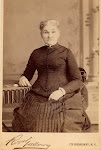
Grace Walch, Daughter of James


Grace was born on June 4, 1885 in Winfield, Kansas and, except for six years in Wichita, spent her entire life there. On June 16, 1908, at age 23, Grace was married in Winfield to Ernest A. Benkendorf, 29, the son of Wilhemina Arndt and Julius Benkendorf, a Prussian emigrant miller. Ernest was a real estate broker in Winfield whose early career was interrupted by tuberculosis. He died at age 33 in California where he had gone for treatment. Grace and Ernest had one child, Dorothy.

Grace then married Peter Hickerson, a photographer who operated a studio in Winfield. They had no children and eventually divorced. In October of 1936, 51-year-old Grace married Charles Gaines in Ozark, Missouri. Charles, who was a widower with two grown sons, worked as a building contractor in Wichita. In that same month of 1936 Grace's only child Dorothy died at the early age of twenty-six. Grace's grief may have been somewhat lightened by the fact that Dorothy had three children before she died. Grace and Charles lived in Wichita for six years, before moving to Winfield. Grace was no doubt well known in downtown Winfield for she worked as a saleswoman for Calvert’s Department Store for about 18 years.

Charles died in 1963 at the age of 83 in Winfield. Grace died three years later at age 81 on June 7, 1966 in Winfield and is buried near her parents in Union Cemetery.

Dorothy Benkendorf’s daughter, Mary Louise Mackensen and her two daughters- Cait and Christine Hendron - have been very active in researching Walch history. They were the source, via Cait, for much of the James Walch history and for all the Winfield photographs.

The photograph above is Grace Walch and her daughter Dorothy Benkendorf. The photograph is courtesy of Cait Hendron of Glendale, Arizona.

Jessie Amelia Walch, Daughter of James


This begins a new section of the Walch history. Having finished the lives of Stephen Walch and Elizabeth Charnock’s children, we now turn to the next generation of cousins.


Jessie Walch was born in 1877 in New York and raised in Winfield, Kansas. In about 1903 at age 25, Jessie married John W. Mendenhall, son of Isaac Mendenhall and Emily M. Paris. John was born in Missouri in 1874 and moved with his family to a farm in Liberty Township of Cowley County when he was about four years old. Jessie and John had three children, all of whom were born in Kansas: Howard W., John Harold, and Pansy. Following Pansy’s birth in about 1911, the Mendenhalls moved to Las Animas, Colorado, where John operated a plumbing shop. They lived at 348 Saint Vrain Ave in Las Animas in 1920 and 1930. They also lived for a time in Grand Junction, Colorado. John died in 1945 at age 74. Jessie died in 1961 at age 84 and was buried beside John in the Las Animas Cemetery. At this time there is nothing known about their descendents.

The photograph is Jessie with her younger sister Grace. The photograph is courtesy of Cait Hendron of Glendale, Arizona, a great-grandniece of Jessie Walch.

Monday, September 15, 2008

The Oklahoma Land Rush -- The Walch Claims


On March 23, 1889 President Benjamin Harrison proclaimed that a two million acre region in the heart of the Indian Territory was open for settlement. The land, which was previously set aside for Indian relocation, was surrounded by tribal owned land: The Cherokee Outlet on the northern Kansas border; the Iowa, Kickapoo, and Pottawattamie reservations on the east; the Chickasaw Nation on the southern border; and the Cheyenne and Arapahoe Reservation on the western border.

Less than a month later the largest accumulations of would-be settlers massed along the Kansas border, primarily at the railroad towns of Arkansas City and Caldwell. On April 18th the crowds at Arkansas City and Caldwell were escorted by U.S. Army troops across the Cherokee Outlet to the border of the ‘Unassigned Land.’ The Caldwell crowd was composed of 10,000 farmers, cowboys, and old soldiers in buggies, covered wagons, and on horseback. They helped one another ford the Cimarron River before making final camp at Buffalo Springs north of Kingfisher. On Easter Sunday, the day before the land rush, the camp took on a festive atmosphere; following religious services, foot races were held and baseball played.

The rail station at Guthrie and the land office at Kingfisher were two sites of choice for settlers and town site corporations. They also were the sights of choice for the Walch family. William W. Howard, writing for Harper's Weekly, followed the crowd to Guthrie:

"In some respects the recent settlement of Oklahoma was the most remarkable thing of the present century. Unlike Rome, the city at Guthrie was built in a day. To be strictly accurate in the matter, it might be said that it was built in an afternoon. At twelve o'clock on Monday, April 22nd, the resident population of Guthrie was nothing; before sundown it was at least ten thousand. In that time streets had been laid out, town lots staked off, and steps taken towards the formation of a municipal government. At twilight the campfires of ten thousand people gleamed on the grassy slopes of the Cimarron Valley where the night before the coyote, the gray wolf, and the deer had roamed undisturbed. Never before in the history of the West has so large a number of people been concentrated in one place in so short a time. To the conservative Eastern man, who is wont to see cities grow by decades, the settlement of Guthrie was magical beyond belief; to the quick acting resident of the West, it was merely a particular lively town-site speculation.”

“The preparations for the settlement of Oklahoma had been complete, even to the slightest detail, for weeks before the opening day. The Santa Fe Railway, which runs through Oklahoma north and south, was prepared to take any number of people from its handsome station at Arkansas City, Kansas, and to deposit them in almost any part of Oklahoma as soon as the law allowed; thousands of covered wagons were gathered on camps on all sides the new Territory waiting for the embargo to be lifted. In its picturesque aspects the rush across the border at noon on the opening day must go down in history as one of the most noteworthy events of Western civilization. At the time fixed, thousands of hungry home-seekers, who gathered from all parts of the country, particularly from Kansas and Missouri, were arranged in a line along the border, ready to lash their horses into furious speed in the race for fertile spots in the beautiful land before them. The day was one a perfect peace. Overhead the sun shone down from the sky as fair and blue as the cloudless heights of Colorado. The whole expanse of space from zenith to horizon was spotless in its blue purity. The clear spring air, through which the rolling green billows of the promised land could be seen with unusual distinctiveness for many miles, was as sweet and fresh as the balmy atmosphere of June among New Hampshire's hills.”

“As the expected home-seekers waited with restless patience, the clear, sweet notes of a calvary bugle rose and hung a moment upon the startled air. It was noon. The last barrier of savagery in the United States was broken down. Moved by the same impulse, each driver lashed his horses furiously; each rider dug his spurs into his willing steed, and each man on foot caught his breath hard and darted forward. A cloud of dust rose where the home-seekers had stood in line, and when it had drifted away before the gentle breeze, the horses and wagons and men were tearing across the country like fiends."

All was not milk and honey when the boomers reach the promised land. Much of the land around Guthrie station was already staked out by "Sooners" which included US Marshals and railroad workers. The rules which made them ineligible for claims were simply ignored. It was fortunate that alcohol was prohibited in the new territory, said one reporter, because blood surely would have filled the newly forming streets otherwise.

John Walch may have been one of those Sooners, for after all he was a railroad man. And his brother-in-law Tom Drew in Caldwell may have used his influence to get there sooner as well. As mentioned before, William Walch later submitted a billing to the Guthrie Board of Education for his labor during the construction of its first school. It cannot be said for certain that any of the Walchs participated in the rush itself, but a year later in the First Territorial Census of Oklahoma of 1890, Thomas Drew and James Walch were property owners in Hennessey of Logan County and in Guthrie of Logan County, respectively. As claimants under the 1862 Homestead Act they could have been granted title up to 160 acres of public land if they remain on it, “improved” and developed it for five years. They most likely kept their primary residencies in Caldwell and Winfield, and stayed on their claim land to meet minimum residency requirements. Although in the case of Tom Drew, he may have made a longer commitment to the claim because his two sons eventually operated general stores in the towns immediate north and south of Hennessey - which we will turn our attention to in a future blog.


For William W. Howard’s full article in Harper's Weekly, (18 May 1889), go to www.library.cornell.edu/Reps/DOCS/landrush.htm

Thursday, September 11, 2008

Another Methodist amongst Us – John Wesley Walch


I received several e-mails from Walch kin, two of which I would like to share with you now, both from the great granddaughters of John W. Walch. Their father, John Arnett Walch, died this April at the age of 92 in Seiling, Oklahoma. I talked to him by phone a few years ago. He was very helpful in providing family background information, including the fact that the family sometimes used the name Welch when they lived in New York. It was this tip that helped me locate them in census records. Jack also put me in contact via e-mail with his daughter Barbara Ann Walch of Tishomingo, Oklahoma, who provided more information.


I recently came across Jack's obituary on the Internet which prompted me to write to Barbara to assure that I still had a connection to this branch of the family. She e-mailed me back today as did her sister Mary Louise Walch of Charlotte, North Carolina. Mary Lou provided some additional information about her grandfather Earl Walch and her father Jack. I'll include it in brief biographies of them which will be subjects of future blogs. But for now I like to share a bit of Mary Lou's correspondence: “Our grandfather is Earl “Pop” Leslie Walch who lived in Cherokee Oklahoma… [And in regard to his father John W. Walch], I thought his name was John Wesley Walch, and that he was known as ‘Little Jack’. Curiously, our families are still Methodist, and it was very interesting to read all the Methodist connection." Mary Lou went on to say that she never thought there were any other Walch kin in the world so she found this history quite interesting.


Of course, we all know that John Wesley (1703-1791) was a famous Anglican minister and theologian, and an early leader in the Methodist movement, (See photo above). So, we now know that Elisabeth Charnock Walch did not name one but two of her sons after famous Methodist leaders.


One time I said that Fletcher was a name that we should keep in circulation in the family. Wesley is another one -- although Wesley Walch seems a bit too alliterated. In most branches of the family that combination would not occur, for with the passing of John Arnett Walch only one branch of the Walch family tree now bears the surname Walch, that branch being the descendents of William Fletcher Walch.

. . .

I have one more blog to finish on the first generation of Kansas Walchs. I'll then turn my attention to the next generation of cousins, which is my grandfather's generation. I will then add a few miscellaneous biographies to complete the Walch family history. Hopefully some of you will help in this endeavor.


As we move closer to current generations I will be more cautious about personal information, given security problems created by the Internet. Of course any good conman or identity thief can learn almost anything about you from existing and readily available information on the Internet. But I don't want to add to it. So I will only use the maiden names of living Walch cousins in this phase of the history. If you want to communicate with any of them, e-mail me and I'll make the connection.

Wednesday, September 3, 2008

Ike Walch of Caldwell, Kansas


Isaac Peter Walch was the seventh and last child of Stephen Walch and Elizabeth Charnock. He was born in 1863 most likely in Hastings-on-Hudson, New York. His older sister Maggie, who was 13 years old at the time, would have helped in the care of her infant brother; and it was possibly that early bonding which cemented a lifelong relationship between the two.

At about the age of 16 Isaac, known as Ike, immigrated with his sister and brothers to Kansas. During the 1880 US Census of Caldwell, Kansas, Ike was living with his sister Maggie’s family and was working as a stonemason, most likely for his brother-in-law Tom Drew.

In about 1883 at the age of 20, Ike married a farmer’s daughter, Julia A. Booth, from nearby Bluff Township. In March 1885, Ike, Julia, and their six-month-old daughter Lillian were living next door to the Thomas and Maggie Drew family. He was still working as a stonemason at that time. Ike and Julia eventually had two more children: Viola, around 1885 and Isaac, Jr., in February 1887. Viola died in infancy and was buried in the Caldwell Cemetery.

If there were slow periods in the stone masonry business, Ike may have worked on the railroads as well. Caldwell in the late 1880s had become a major railway shipping point for cattle and was now home for many railroad workers. In any case, his work career was brief, for he died in 1889 at 26 years of age. He was the youngest and first of the Kansas Walch brothers to die. His wife Julia was 25 at the time and their two children Lillian and Ike, Jr. were 5 and 2 years old.

Two years after Ike’s death, Julia married Frank Robieson and had two more children: Frank, Jr., born in 1894 and Agnes, born in 1895. By 1900, the family was living at 710 E. 19th St. in Winfield. Frank was working as a mechanic and Julia as a bookkeeper at the time.

Julia died on September 3, 1947 in Winfield, 11 days before her 83rd birthday. She was buried in Graham Cemetery in Winfield near the grave of her father Wiley Booth.

Ike Walch, Sr., was buried in the Caldwell Cemetery next to the graves of his infant daughter Viola and his sister Margaret.


. . .


Two family branches carry a story of a Walch family member being hung for horse thievery. If there is any truth to those rumors, then Ike would be the likely candidate, given the brevity of his life and the common practice of such hangings around Caldwell during his time. If ranch hands caught an individual with either a stolen horse or cattle, they were often hung on the spot without trial. However, there is no proof whatsoever that this was Ike’s fate. It simply may have been a good yarn.

Tuesday, August 19, 2008

William F. Walch – Minister of God & Drugs (Part II)


On June 9, 1880 the census taker found W. F. Walch, 22, living alone at his home in Harper Township. Under the heading Occupation the census taker simply wrote that W. F. was "at home." Normally he would have written "unoccupied" for the able that were unemployed. So, what was occupying W.F. on that June 9th? Possibly, he was settling his affairs in Harper just three months after he moved there. A week before on June 2nd William Fletcher Walch had married Caroline "Carrie” Leasure, 22, in Pawnee County, Kansas. Carrie was the daughter of John Boyd Leasure a shoemaker and cobbler in Larned. William had returned from Larned that week, a distance of 120 miles, and left the care of his bride to her family.

William eventually returned to his wife in Larned where their first child was born on the 20th of March in 1881. William Wilbur Walch, who was called Will, said he was born in a sod house -- the ‘starter home’ for newlyweds in Kansas at that time.

Prairie grasses covered much of Kansas then -- Big Bluestem, Switchgrass, and Buffalo Grass, just to name a few. Over centuries of grow, these grasses created a thick, root-bound turf that was tough yet flexible, and was a ready building material where lumber was in short supply. The sod was cut into thick squares and stacked as building blocks. The most primitive were simply igloo-like dwellings, but most were rectangular, sod walls supporting a beamed roof, which was also covered in sod. A wooden door and a window or two completed the structure. One drawback was that it often leaked, leading to wet bedding and clothing after a heavy rain. Not the most hygienic home, but it proved to be cool in the hot Kansas summer and warm in the winter. But as soon as they could afford it, a farm family would build a lumber frame house and leave the sod house to slowly decay.

In 1800, the city of Larned was a bustling cow town on the Santa Fe Trail, just 60 miles up the trail from Dodge City. In 1878, Larned was the largest city in Pawnee County with a population of 716, which was 40 percent of the county population. Larned was first settled just eight years before William Walch arrived, and was growing at such a rate that the agricultural production in the county had increased by more than 2,708 percent in the four years prior to his arrival. The Walchs would add one more child to this boom: Lizzie Belle Walch on the 26th of June 1883. The following year, the 1884 Kansas State Census shows the W. F. Walch family of four living in the city of Larned, where William was working as a druggist.

On January 28, 1887 William and Carrie’s last child was born in Topeka, Kansas: Stephen Fletcher Walch (my grandfather). Two years later William was likely the same W. Walch who submitted a bill for $2.70 for 18 hours of labor on the construction of the first school in Gutherie, Oklahoma - the same town in the same year his brother James staked a claim in the Oklahoma Land Rush of 1889.

When Stevie Walch was a young boy his father left home to ostensibly find better work. It is not known whether the marriage was strained before he left or if the time away took its toll. In any case William never returned home; and the marriage dissolved.

William may have gone to California for a time but eventually returned to Hastings-on-Hudson where he stayed with his mother. By 1900, 42-year-old William was living in Baltimore, Maryland, on 1001 Scott St. with his new wife, Alice Z. Walch, 37, of New York. He was working as a drug clerk at the time.

William died in 1906 at age 48 in a streetcar accident in Poughkeepsie, New York. It was said that he was buried there in Union Cemetery but the cemetery record does not list him. Perhaps he was buried alongside other family members in Hastings. In any event, his wife Alice returned to Yonkers where she was working as a hotel housekeeper in 1910.

Back in Arkansas City, Kansas, William children were fathered by their Grandfather John Leisure, who had moved to “Ark City.” There was at least one upside to William's absence: years later his son Stephen said his deep sense of abandonment as a child helped to steady him through rough periods of his own marriage, the rough periods all marriages inevitably encounter.

The first photo above is Main Street of Larned, Kansas, in 1880. The William Walch family photograph is courtesy of Anne Haskin of Lansing, Michigan, William’s great-granddaughter. Click on photo to enlarge.

Friday, August 8, 2008

William F. Walch – Minister of God & Drugs (Part I)


William Fletcher Walch, the sixth child of Stephen Walch and Elizabeth Charnock, was born on November 8, 1857 in Hastings-on-Hudson, New York. He was named in honor of John William Fletcher, an early Methodist theologian, whose early writings on piety were popular among Methodist at that time.


William's early years were spent in Hasting. Around 1878 at the age of 20, he went to Kansas either at the same time as his sister Elizabeth's family or shortly after. And like his brother James, he would have ridden the train to Wichita and then walked the 60 miles to Caldwell. He may have gone to help the Drews build their new home in Caldwell or possibly to work in his brother-in-law's fledging construction business. Whatever his reasons for going he didn't stay in Caldwell long. In 1880 William moved further west to neighboring Harper County.


The Rev. W. F. Walch of Harper, Kansas


The Methodists were among the first denominations in Kansas. Their method for expansion called for established churches to raise missionary funds to support young Methodist circuit riders who rode from settlement to settlement, through the nearly unbroken wilderness to organize congregations. For a brief period in 1880, William Walch served in that capacity.


The city of Harper is Harper County's oldest city and is located in the north-central part of the county. It is 29 miles northwest of Caldwell. Harper’s growth was typical of many other towns in central and western Kansas during that period: a group of people, in this case Iowans, formed the Harper City Town Company at a meeting in Reno County, Kansas, on April 1, 1877. On April 2nd, the company struck out south and engaged the services of a county surveyor in Kingman County. On April 3rd, they ran a survey line from the government cornerstone two miles south of Kingman, south into Harper County. They camped at the future site of the city on April 5th. The following day they ran a line east to another governmental marker. Three surveys were made before the town was finally located on April 14th. On April 16th the building of the first house commenced. The first frame house was completed on April 19th. In May, the first blacksmith shop opened. On July 1st the first postmistress was commissioned. In July, the first grocery store opened, the first child was born, the first lawyer arrived, and the last wild buffalo was killed. In October, a Presbyterian minister preached the first sermon and a physician opened a practice.


"During 1878, the settlement of the town was so rapid as to preclude all specific mention of the settlers who stood not on the order of their coming, but went to work on the boom, which has known no cession for four years," according to William Cutler's History of the State of Kansas of 1883. However, Cutler did mention by name some of the people who arrive after 1878, including Rev. Walsh: “The Methodist church was organized in 1878 with a membership of seven, under the care of Rev. J. W. Anderson. Rev. Messrs. Walsh and Rose held the pulpit in 1880-81. Cutler also noted that earlier services were held in private homes and the schoolhouse. The church was built two years after William’s ministry there.


In Danville, which is located a little over 7 miles east of Harper, Cutler noted that the “Rev. Mr. Walsh” served as the Methodist society’s first pastor and that he “lived in Harper and came down to perform services.”


W. O. Graham, a local Harper historian writing in 1886, also mentioned William and correctly spelled his surname: "Rev. W. F. Walch arrived March 19, 1880, but did not remain the entire year, Rev. J. L. Rose filling out the last quarter and the following year.” The membership had grown to about 80 by 1886. Incidentally, the circuit riders throughout Kansas were so effective that by 1900 Methodists were the largest denomination, representing twenty-six percent of all churchgoers in Kansas.
. . .

This was indeed a brief ministry -five months at best. But, we shall learn in the next blog that the 22-year-old Rev. Walch had new obligations to meet and that he would turn to drugs to fulfill them.


The photo of William Walch is courtesy of Anne Haskin of Lansing, Michigan, a great granddaughter of W. F. Walch. (Click on photo to enlarge)